A situation puzzle turns a whole class into people who have to build questions. Every question gets an answer straight away, and that answer also tells the learner whether the sentence worked. In most lessons the teacher asks and the class answers; here it runs the other way for fifteen minutes. This is how we’d run one in an English class, what language it practises, and how to pick the text. For the record, we make Post Mortem, a game of dark riddles, and the statements we point to are ours.
In this article
Why it works in a language class
You read out a scene that doesn’t add up. The class asks questions you can only answer with yes or no, and the story comes back piece by piece. Every turn is a question the learner has built, for a real reason: they want to know. Nobody is reading from a script.
The answer comes at once, and it doubles as feedback. An open question, or one too muddled to answer, gets “rephrase”. Our rules already have the narrator ask for clearer wording when a question is ambiguous. The learner then has to find a new form, not a new idea. “Irrelevant” teaches something else: that detail doesn’t help explain the story. Sorting what matters from what doesn’t is a listening and reading skill as much as a game one.
Teachers already use the format. The British Council’s TeachingEnglish site has an A2 lesson built on one well-known lateral thinking story: learners put the story back in order, talk about what explains it, then find the past continuous in it before a role play. What follows is a different use of the same kind of story, as a speaking activity, with statements you can put on a screen without the answer printed underneath.
On this site
Sources
The language it practises
Mostly, the grammar of the question itself. Four areas come up in almost every game.
- Auxiliaries, all lesson long. A yes/no question needs one, and the game asks for dozens: Did he…? Was she…? Had they…? Is there…? Could it…? The classic errors show up within minutes, “Did he went?” or a bare “He was alone?” with rising intonation. The second is fine in conversation, so decide before you start whether you accept it. We would at A2, and ask for the auxiliary from B1.
- Past simple against past perfect. Most of our statements are told in the present, and whatever explains them happened earlier. That gives the past perfect a job: “Had he met her before that night?” asks something “Did he meet her?” doesn’t, and the answer can change the story.
- Modals of speculation. Once a theory takes shape, the room starts thinking aloud: “He must have known.” “She might have lied.” “It can’t have been an accident.” As a closed question: “Could he have seen it from the street?” Must, might, can’t and could have carry the second half of the game and most of the final retelling.
- Open to closed. “Why did he do it?” gets “rephrase”. The learner has to turn one reason into a yes/no question: “Did he do it for money?” It’s the same move native speakers make when they play.
Choosing a text
Every riddle in our library has a difficulty from one to three stars. One star means one idea to find; three means a whole backstory to rebuild stage by stage. Start with one star.
Most of our stories are about death. The game is called Post Mortem, and even when the statement shows an ordinary scene, the solution can be dark. We won’t tell you which ages or groups it suits. That’s your call, and to make it you need to read the statement and the solution before the lesson. For a group you think may find the subject hard, start with the modern-life collection. It is built on jobs, screens and daily routines, and several of its one-star statements have no body in them at all.
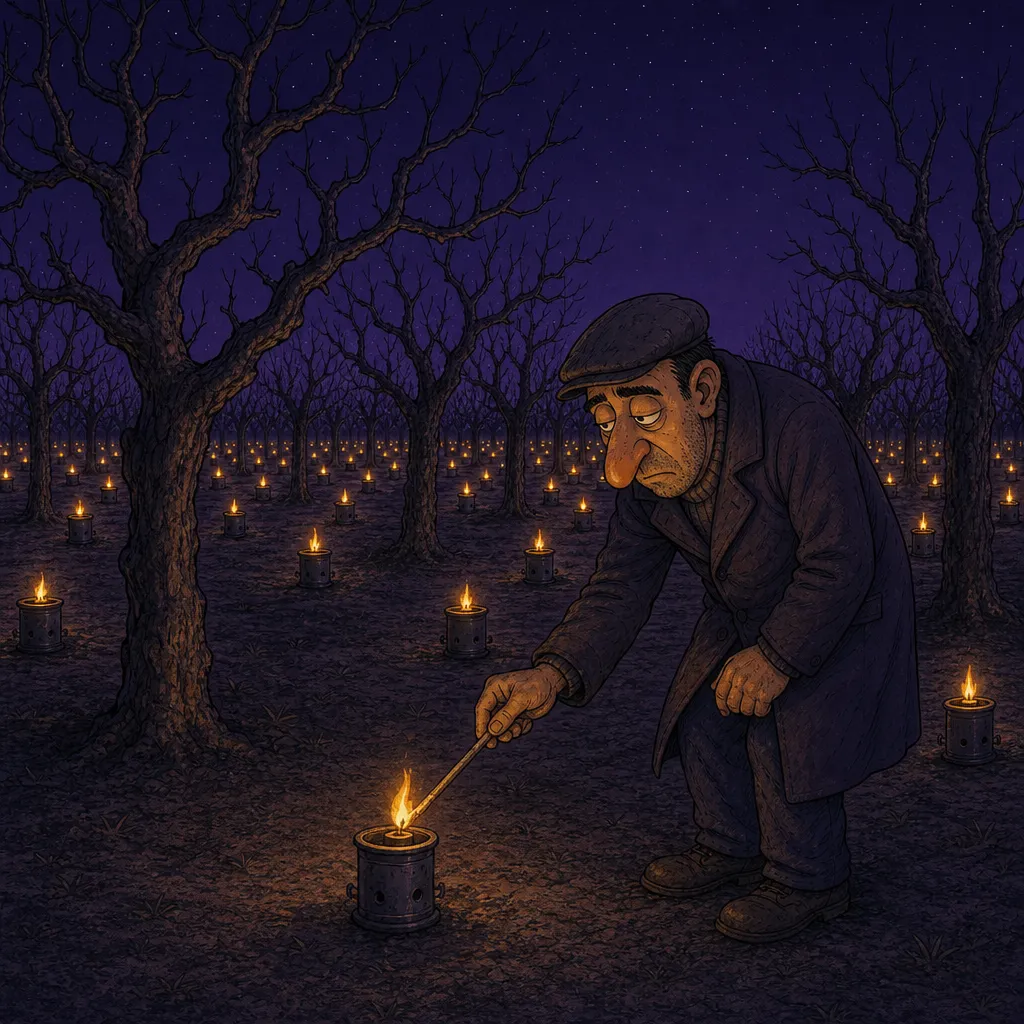
Here is one, Fires in the Orchard, one star, from that collection:
“At three in the morning a man walks his orchard, lighting hundreds of small flames one by one between the trees. He is not lighting the place up, he is not smoking anything out, and he burns nothing that grows there. At sunrise he blows every flame out and goes to bed. Why?”
An A2 group may need “orchard” and “smoke out”. If two or three words in the statement would stop the class understanding it, teach them first, only words from the statement, and without fuss. A word introduced too carefully turns into a hint.
Your prep: the answer lives in the app
To answer the class you need to know the story, and the solution only lives in the Post Mortem app. The easiest way in is to solve the riddle yourself the evening before, against the app’s narrator: you’ll notice where the questions get stuck.
Then write down, for yourself, the three to five facts the class has to find, and decide what the story leaves open. Those questions get “irrelevant”, every time, with every group. Our host’s guide goes through this prep step by step.
In class, project the riddle’s page on this site: the picture and the full statement, never the solution. Our English statements are written in English, not translated from French.
A lesson outline
An outline to try for a first go, not a tested method: you know your class better than we do. Allow about fifteen minutes with a one-star riddle, or ten without the board.
- Project the statement and read it aloud. Check the words are understood, not the story.
- In pairs, learners agree on one question before anyone asks it. This is where the language work happens: they argue about the form as much as the idea.
- On the board, two columns: true and false. Every useful yes and no goes up as a full sentence, written by a learner. Irrelevant details go in a corner so nobody asks them again.
- You answer with three words only: yes, no, irrelevant. Plus “rephrase” when a question can’t take one of them. No “nearly”, no knowing smile.
- When someone thinks they have it, they tell the whole story in the past. The class fills gaps or corrects it from the board.
- Then you tell the real story. It’s a listening task everyone actually listens to.
Adapting it by level
At A2, stay with one star and put question starters on the board before you begin: Is there…? Was it…? Did he…? Did someone…? Give pairs more time to prepare each question and recap the board more often. Rising intonation without an auxiliary is fine at this level if it gets the question across.
From B1 up, let the questions run free and set one constraint instead: full auxiliaries every time, or at least one past perfect question per pair. Move to two stars. Ask for theories as modal sentences first (“He must have…”), then split into closed questions, and for a final retelling that holds up without looking at the board.
Follow-up: learners write their own
After a few sessions, learners can write a scene of their own. It’s a writing task with a tight brief, and the rules we follow ourselves make a good one: the statement never lies, the paradox fits in one sentence (this, and yet that), and the answer can be reached by asking, with no specialist knowledge.
Each group then hosts its riddle for the class. The roles flip: the writers have to understand everyone else’s questions to answer them, which is a different skill again.
On this site